
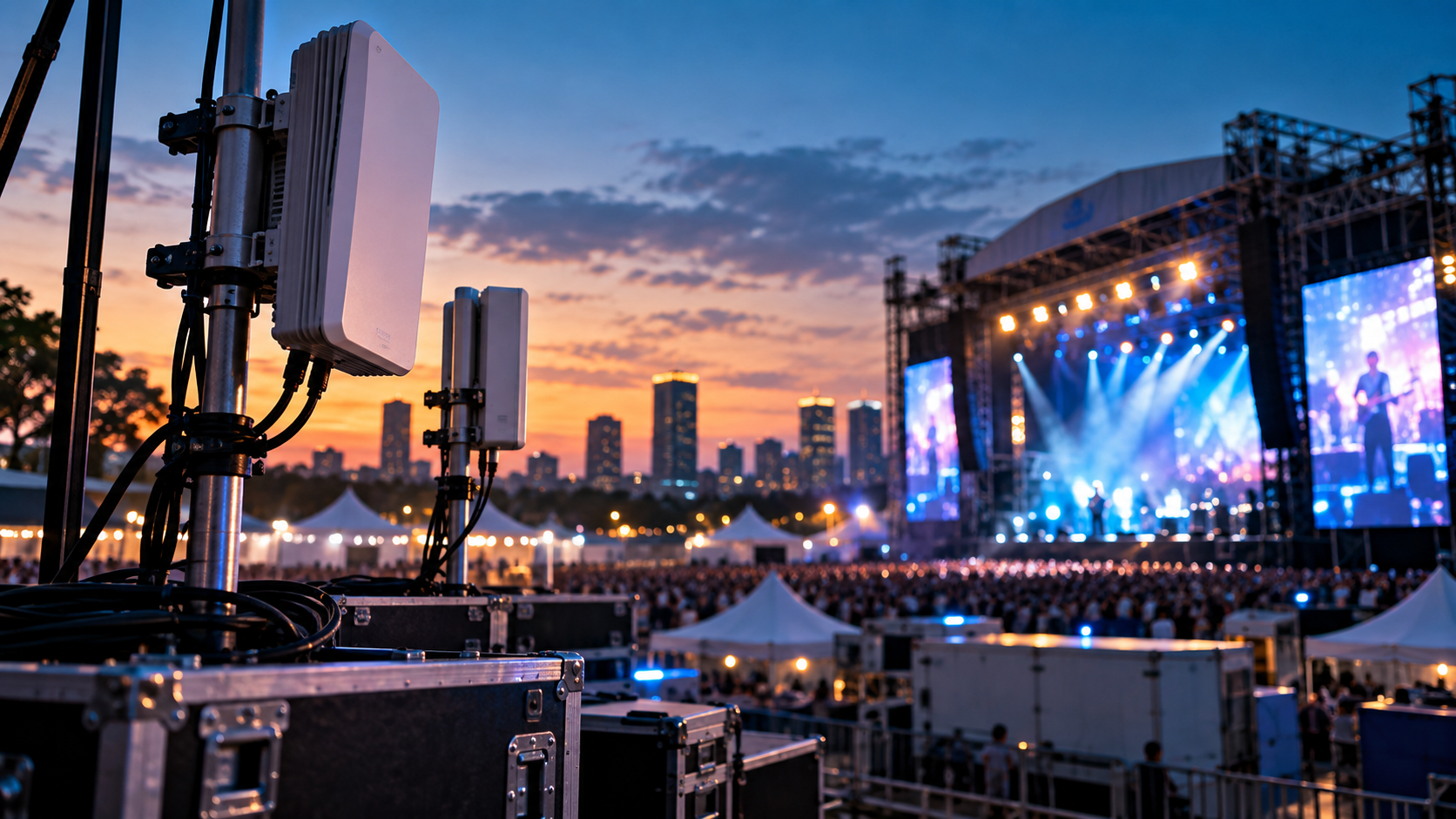
Temporary connectivity is one of the most important—and often overlooked—components of a successful festival or live event.
From point-of-sale systems and ticket scanning to production teams, vendors, security, and guest Wi-Fi, modern events depend on reliable connectivity. But traditional wired internet services can take weeks or months to install, making them impractical for temporary venues.
Why Fixed Wireless Works
Fixed wireless can provide high-speed connectivity without waiting for traditional construction or carrier installation timelines. Using wireless infrastructure, connectivity can often be deployed quickly and positioned where it is needed most across an event site.
Built for Temporary Environments
Festivals and large gatherings create unique network challenges. Thousands of devices may be competing for connectivity while production teams, vendors, and operational systems require reliable bandwidth.
A properly designed temporary network can support critical applications such as ticketing and access control, point-of-sale systems, production communications, vendor operations, security systems, and guest connectivity.
Reliability Requires Planning
Temporary does not mean improvised. Reliable event connectivity requires an assessment of the venue, bandwidth requirements, coverage areas, redundancy, network security, and the number of users and devices expected onsite.
Connectivity That Moves With the Event
Fixed wireless gives organizations the flexibility to deploy connectivity where traditional infrastructure is unavailable, impractical, or simply too slow to install.
For festivals, live events, temporary venues, and production environments, the result is a network that can be deployed quickly, scaled appropriately, and removed when the event is over.