
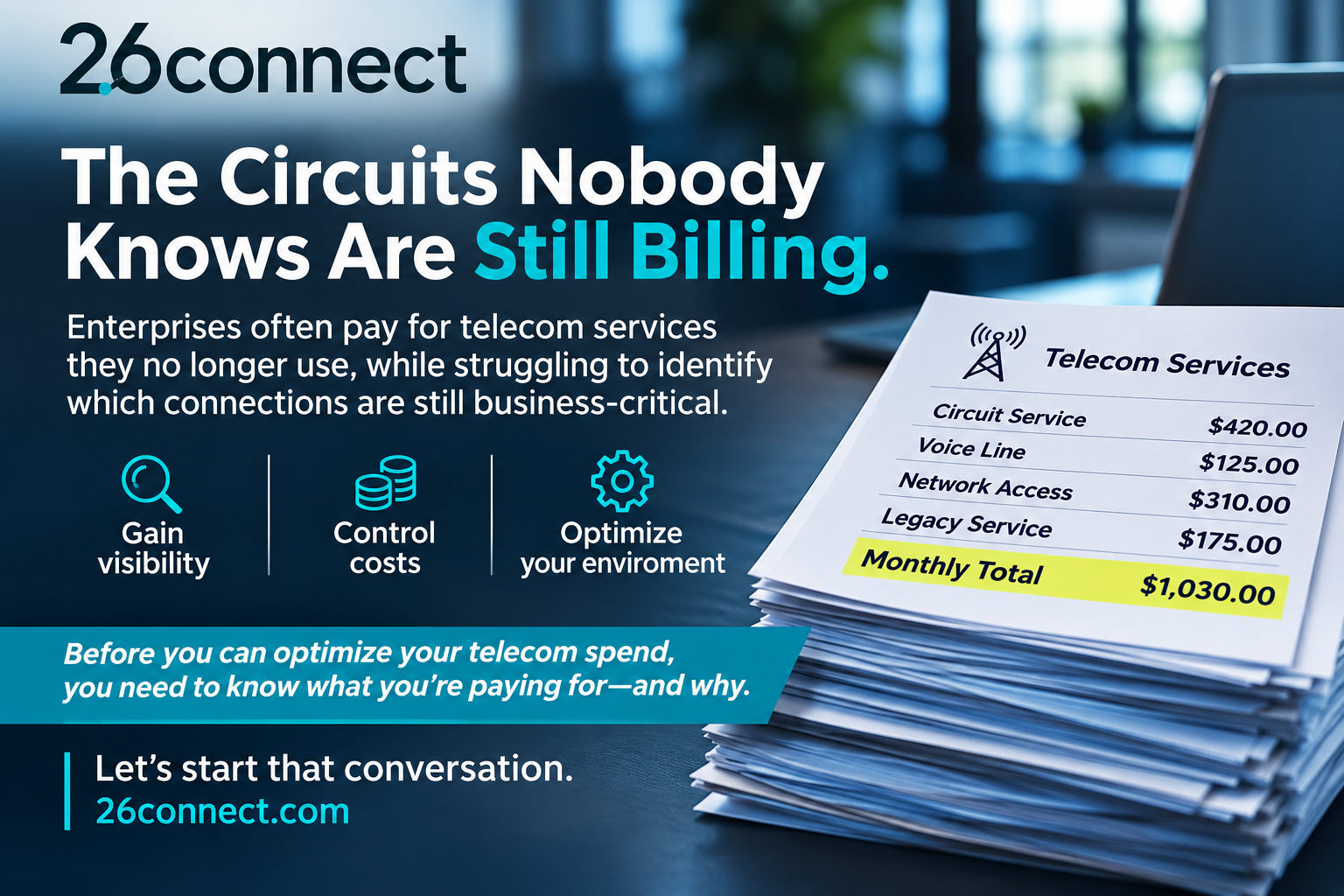
Why enterprise telecom visibility is the first step toward controlling costs and optimizing infrastructure.
Enterprise telecom environments rarely become complicated overnight. Complexity builds gradually as organizations expand, acquire businesses, relocate offices, change providers, and adopt new technologies.
Along the way, something frequently gets overlooked: the infrastructure already in place.
Circuits remain active after locations close. Redundant connections continue billing. Contracts renew automatically. Services that were once essential may no longer support current business requirements.
The result? Organizations can spend significant amounts on telecom infrastructure without having a complete picture of what they're paying for.
For enterprises managing multiple locations, telecom inventories can become fragmented across carriers, departments, billing platforms, and legacy systems.
IT teams may have detailed knowledge of their core network but limited visibility into every individual circuit, service agreement, and recurring charge.
Common challenges include:
Without an accurate inventory, identifying opportunities for improvement becomes difficult.
Disconnecting services without understanding their purpose introduces unnecessary risk.
Some circuits may appear underutilized but serve important functions such as redundancy, disaster recovery, or critical operational connectivity.
Effective telecom optimization requires more than reviewing invoices.
It requires understanding how each service supports the business, validating utilization, and evaluating the operational impact of potential changes.
The objective isn't simply to eliminate services.
It's to ensure every service has a purpose, delivers value, and supports the organization's current requirements.
At 26connect, we believe telecom optimization begins with visibility.
A structured approach includes:
1. Infrastructure Discovery
Identify existing telecom services, carriers, locations, circuit identifiers, and associated billing information.
2. Inventory Reconciliation
Compare carrier records, invoices, and internal documentation to establish an accurate understanding of the environment.
3. Utilization and Cost Analysis
Evaluate services for redundancy, underutilization, outdated technologies, and potential billing discrepancies.
4. Optimization Planning
Develop recommendations for service consolidation, contract adjustments, carrier alternatives, and infrastructure modernization.
5. Implementation and Ongoing Management
Coordinate approved changes with providers, validate results, and establish processes to maintain accurate inventories moving forward.
Telecom expense management shouldn't be limited to an occasional billing review.
As organizations evolve, their networks must evolve with them.
Maintaining visibility into telecom infrastructure helps IT leaders make better decisions about capacity, reliability, modernization, and future investments.
It also transforms telecom spending from a collection of recurring invoices into a managed business investment.
26connect works with organizations to simplify complex telecom environments through infrastructure consulting, carrier management, expense optimization, and network lifecycle support.
Our carrier-independent approach allows us to evaluate existing environments and recommend solutions based on business requirements rather than a single provider's offerings.
Whether your organization manages dozens of locations or thousands of services nationwide, understanding your existing infrastructure is the foundation for meaningful optimization.
You can't optimize what you can't see.
Before investing in more infrastructure, make sure you understand what you're already paying for.
Let's start that conversation.